
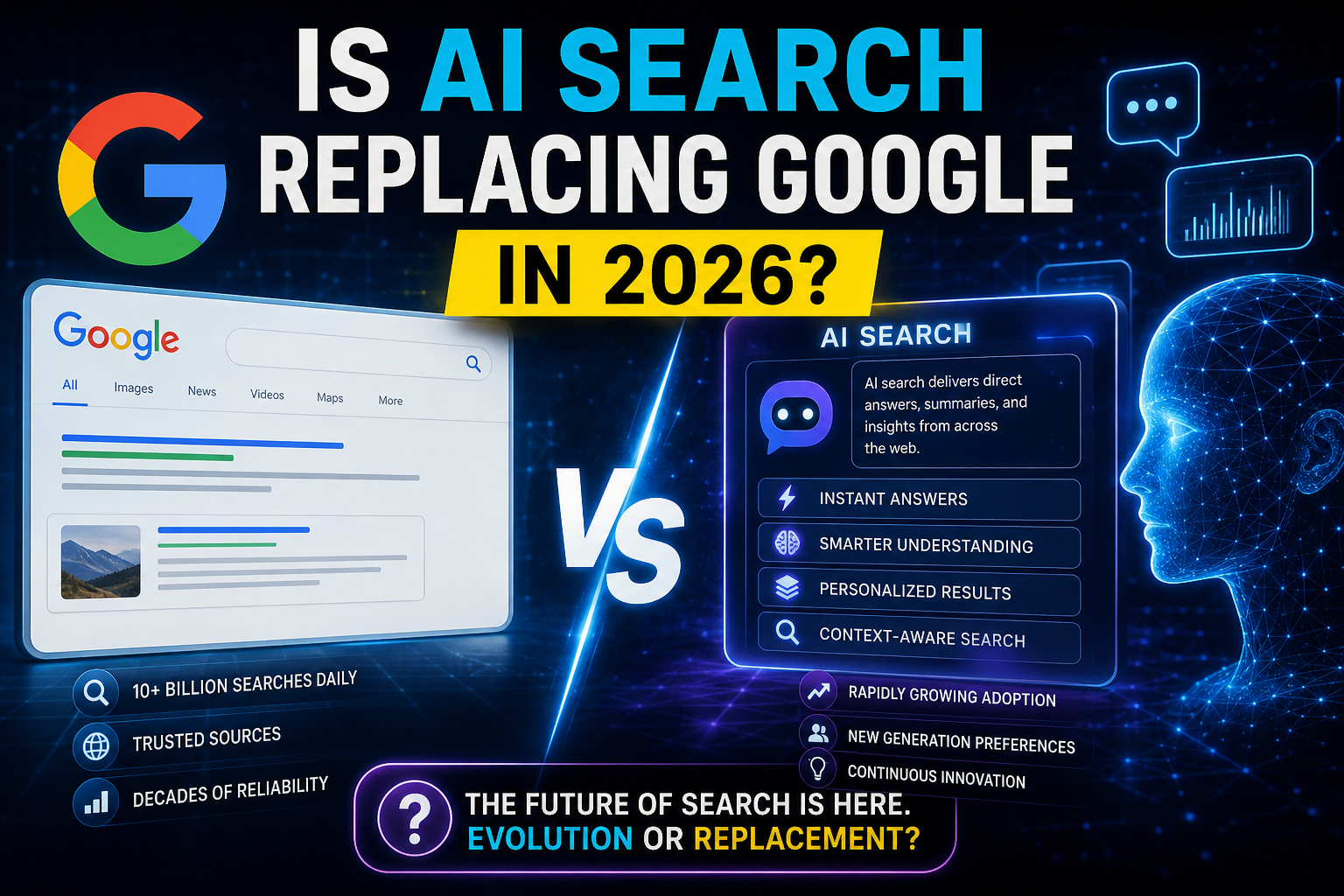
AI-powered search tools have grown enough by 2026 that a genuine question has emerged: is traditional search actually being replaced, or just changing at the margins? The data says something more specific than either extreme. Our ChatGPT vs Claude vs Gemini guide covers the leading AI assistants driving this shift.
In this article
- What the 2026 Numbers Actually Show
- Where Traditional Search Still Clearly Wins
- Where AI Search Genuinely Outperforms
- The Traffic Reality Behind the Hype
- Accuracy Concerns Remain a Real Limitation
- How Different Age Groups Are Splitting Their Behavior
- What Google Itself Says About This Shift
- Quick FAQ
- The Bottom Line
What the 2026 Numbers Actually Show
Google still processes roughly 5 trillion searches a year and holds about 90% of the traditional search engine market, according to StatCounter’s global search data. ChatGPT reached 1 billion monthly active users by May 2026, and OpenAI reports around 700 million weekly users — genuinely explosive growth from roughly 100 million weekly users in early 2024. Yet when researchers filter specifically for search-like queries, ChatGPT’s volume sits at only about 12% of Google’s, per Ahrefs’ analysis of clickstream data.
Perhaps the most telling statistic: a large-scale Semrush study tracking users before and after adopting ChatGPT found no statistically significant drop in their Google search sessions. People aren’t replacing Google searches with ChatGPT prompts — they’re doing both, more often described as the “expansion hypothesis” rather than substitution.
 Also readMeta’s New Personal Agent Protocol: 7 Things to Know Before You Let AI Shop for You
Where Traditional Search Still Clearly Wins
For real-time information, local business searches, and shopping comparisons, traditional search’s link-based results remain more practical than a single AI-generated answer. The table below reflects how these use cases actually split in practice:
| Search Need | AI Search (ChatGPT/Gemini) | |
| Breaking news | Strong | Weak |
| Local search | Strong | Weak |
| Shopping / price comparison | Strong | Moderate |
| Complex, multi-source research | Moderate | Strong |
| Quick factual answers | Moderate | Strong |
Where AI Search Genuinely Outperforms
For complex questions requiring synthesis across sources and conversational refinement, AI chat tools often win. This is reshaping click-through behavior directly: Ahrefs found that when Google shows an AI Overview, organic click-through rate for the top position on informational queries fell from 7.3% in December 2023 to just 1.6% by December 2025 — a drop of roughly 78%. Pew Research’s survey data separately found 34% of U.S. adults had used ChatGPT by mid-2025, double the share from 2023, with usage skewing notably toward younger, more educated users.
The Traffic Reality Behind the Hype
Despite ChatGPT’s massive user base, Google still sends approximately 190 times more referral traffic to websites than ChatGPT does, according to the same Ahrefs analysis. Google accounts for close to 40% of website traffic overall, while ChatGPT contributes roughly 0.21%. This matters enormously for publishers and businesses: being cited inside an AI Overview or chat response, rather than ranking traditionally, is emerging as its own distinct visibility channel — brands cited inside AI Overviews reportedly see 35% more organic clicks and 91% more paid clicks than those that aren’t, per Search Engine Land’s ongoing AI search coverage.
Accuracy Concerns Remain a Real Limitation
AI-generated answers, whether from a standalone chatbot or embedded in search results, can still present incorrect information confidently — a well-documented limitation known as hallucination. For anything with real consequences (medical, legal, financial decisions), verifying AI-generated answers against primary sources remains genuinely important, regardless of how polished or confident the response reads.
How Different Age Groups Are Splitting Their Behavior
The generational divide here is genuinely significant, not just anecdotal. Younger users are adopting AI-first search habits considerably faster than older cohorts — some survey data suggests a meaningful share of users aged 18-29 now reach for AI tools before Google when researching products or recommendations. ChatGPT’s own user base skews younger, more educated, and increasingly global compared to Google’s much broader, more universal user base. This split matters for content strategy: publishers targeting younger audiences may need to weigh AI-citation visibility more heavily than older, more Google-dominant audiences. Our Rise of On-Device AI guide covers a related generational shift toward AI-integrated tools built directly into phones.
What Google Itself Says About This Shift
Google has publicly stated that AI Overviews drive over 10% more overall Google usage for the query types where they appear, based on the company’s own internal testing. In other words, by Google’s own measurement, AI-generated answers are growing total Google usage rather than cannibalizing it — a claim that lines up with the broader “expansion” pattern seen in independent research. This is a meaningful data point directly from Google’s own search documentation, since it comes from the company with the most complete internal visibility into how these features actually affect user behavior.
Quick FAQ
Is AI search better than Google? Depends on the task — better for complex synthesis and quick factual answers, worse for real-time, local, and shopping queries where Google’s link-based results still win.
Will AI replace Google Search? The evidence so far points to expansion, not replacement — Semrush’s clickstream research found ChatGPT adoption didn’t reduce users’ Google search activity.
Is Google losing search traffic to AI tools? Google’s overall search share has dipped slightly (below 90% for the first time in over a decade per StatCounter), but it still dominates total query volume by a wide margin.
How should websites optimize for AI search? Focus on clear, citable answer blocks near the top of a page — AI Overviews and chat tools favor structured, directly quotable content over long, unstructured prose.
The Bottom Line
AI search isn’t replacing Google — it’s splitting the market by query type, exactly as the 2026 data shows: Google still handles roughly 8 in 10 digital queries once AI tools are counted, while AI chat tools have carved out a genuine, fast-growing niche for complex, synthesis-heavy questions. The more useful habit for both users and website owners isn’t picking one tool exclusively, but understanding which type of query each one actually serves best — and, for publishers, optimizing for citation inside AI answers as a distinct, additional visibility channel alongside traditional rankings.

2 Comments