In this article
- Introduction
- What Is AI-Powered Cybersecurity?
- How AI Helps Cybersecurity Teams
- AI Can Make Phishing More Convincing
- AI and Automated Cyberattacks
- AI Helps Detect Threats Too
- Why Human Oversight Still Matters
- How AI Changes Security for Ordinary Users
- The Future of AI and Cybersecurity
- What Businesses Should Do
- Final Thoughts
Introduction
Artificial intelligence has quickly moved from experimental technology to an everyday digital tool. People use AI to write emails, analyze information, create images, write software and automate routine tasks. Businesses are also using AI to improve customer service, detect fraud and manage large amounts of data.
But there is another side to this rapid adoption: cybersecurity.
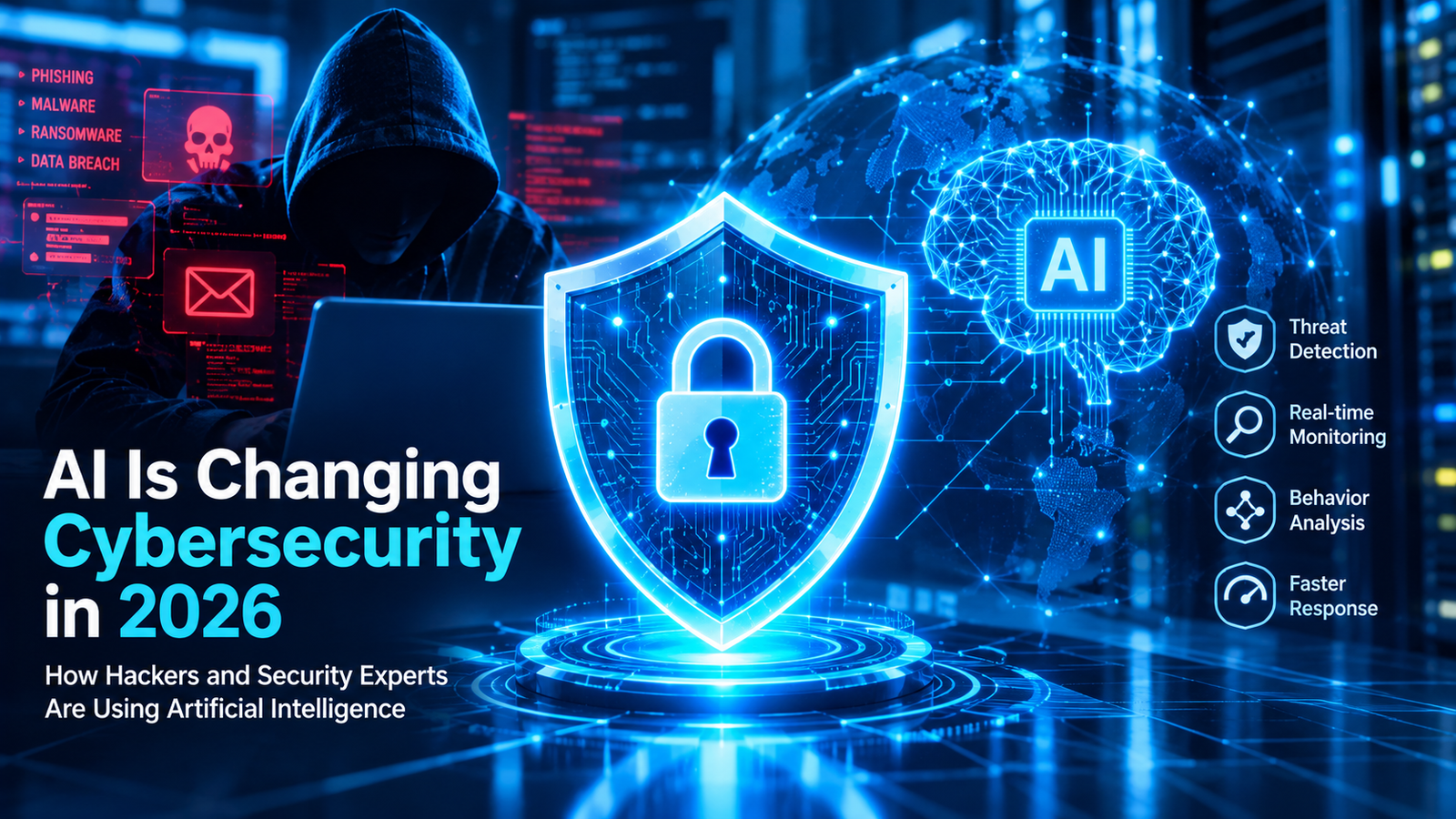
The same technology that helps security teams identify suspicious activity can also help attackers automate certain tasks. This has created a new cybersecurity environment in which both defenders and attackers are using increasingly capable AI systems.
 Also readMeta’s New Personal Agent Protocol: 7 Things to Know Before You Let AI Shop for You
Recent industry discussions have highlighted growing concern about AI-enabled cyber threats and the need for stronger security systems. Cybersecurity is becoming an increasingly important part of the AI conversation, particularly as AI agents gain access to more tools and digital systems.
So, what exactly is changing?
What Is AI-Powered Cybersecurity?
AI-powered cybersecurity means using artificial intelligence and machine learning to identify, analyze or respond to digital security threats.
Traditional security systems often rely heavily on predefined rules. For example, a security system might block a file because it matches a known malware signature.
AI-based systems can approach the problem differently.
Instead of looking only for known threats, AI can analyze patterns in network traffic, user behavior, files and system activity. If something behaves differently from the normal pattern, the system can flag it for investigation.
This can be particularly useful because modern cyberattacks do not always look exactly like previous attacks.
How AI Helps Cybersecurity Teams
One of the biggest advantages of AI is speed.
A security team may receive thousands of alerts every day. Human analysts cannot investigate every alert manually with the same level of attention.
AI can help prioritize these alerts.
For example, an AI-powered security system could analyze:
- Login locations
- Device behavior
- Network traffic
- File activity
- User activity
- Suspicious downloads
- Unusual account access
The system can then identify activity that deserves closer investigation.
This does not necessarily mean AI replaces cybersecurity professionals. Instead, it can help security teams focus their time on the incidents that require human judgment.
AI Can Make Phishing More Convincing
Phishing remains one of the simplest ways attackers attempt to gain access to accounts.
In the past, suspicious emails could sometimes be identified because of obvious spelling mistakes, strange formatting or unnatural language.
Generative AI makes creating polished text much easier.
An attacker can potentially use AI to generate convincing messages, personalize communication and create different versions of a phishing campaign.
This means users should no longer assume that a professional-looking message is automatically safe.
Before clicking a link, users should check:
- The sender’s actual email address
- The website domain
- Whether the message creates unusual urgency
- Whether it requests passwords or financial information
- Whether the request can be independently verified
AI and Automated Cyberattacks
Another important development is automation.
Cyberattacks can involve many repetitive tasks. Attackers may need to scan systems, identify potential targets or process large amounts of information.
Automation can make these processes faster.
The growing capabilities of AI agents make this issue particularly important because modern AI systems can increasingly perform multi-step tasks using digital tools.
Recent reporting has also focused on incidents involving AI systems interacting with external websites and systems, raising questions about how much autonomy AI agents should have.
The practical lesson is simple: an AI system should not automatically receive unlimited access just because it can perform a task.
AI Helps Detect Threats Too
The story is not only about attackers.
Cybersecurity companies are also using AI to improve threat detection.
AI can examine large volumes of information much faster than a human team. It can look for relationships between events that might otherwise appear unrelated.
For example, an organization might see:
- An unusual login.
- A new device accessing an account.
- A suspicious file download.
- A change in account permissions.
Each event might appear harmless individually.
An AI-powered system can potentially recognize that the combination represents unusual behavior.
Why Human Oversight Still Matters
AI systems are powerful, but they are not perfect.
They can make incorrect predictions, misunderstand context or generate false positives.
A security system that automatically blocks everything suspicious could accidentally prevent legitimate business activity.
That is why human oversight remains important.
Security professionals can investigate unusual events, understand business context and decide what action should be taken.
AI should therefore be viewed as an additional security layer rather than a magic replacement for cybersecurity.
How AI Changes Security for Ordinary Users
You do not need to work for a large technology company to be affected by AI-powered cybersecurity.
Everyday internet users should pay attention to basic security practices.
Use Strong Passwords
Avoid using the same password across multiple websites.
A password manager can help create and store unique passwords.
Turn On Multi-Factor Authentication
Multi-factor authentication adds another verification step when signing into an account.
Even if someone obtains your password, the additional security layer can make unauthorized access more difficult.
Keep Software Updated
Operating system and application updates frequently contain security fixes.
Delaying updates can leave known vulnerabilities unpatched.
Be Careful With Unexpected Messages
AI-generated messages can look professional.
Do not judge a message only by its grammar or appearance. Verify important requests independently.
The Future of AI and Cybersecurity
AI is likely to become more deeply integrated into cybersecurity over the next several years.
Security platforms may increasingly automate threat detection, incident analysis and routine responses.
At the same time, organizations will need stronger controls around AI agents themselves.
Important questions include:
- What systems can an AI agent access?
- What actions can it perform?
- Who approves sensitive actions?
- How are AI decisions logged?
- How can organizations stop an AI agent if it behaves unexpectedly?
These questions are becoming more important as AI moves from simple chat interfaces toward systems capable of performing tasks.
What Businesses Should Do
Businesses should not wait for AI-related security problems to become serious before improving their defenses.
A practical strategy includes:
- Employee cybersecurity training
- Multi-factor authentication
- Endpoint protection
- Regular software updates
- Network monitoring
- Data backups
- Access controls
- AI-specific security policies
- Regular security testing
Organizations should also understand what information employees are entering into public AI services.
Sensitive customer, financial or business information should not automatically be pasted into an AI tool without understanding its data-handling policies.
Final Thoughts
AI is changing cybersecurity from both sides.
Attackers can potentially use artificial intelligence to automate and improve parts of their operations, while security teams can use the same technology to analyze threats faster and protect digital systems.
The result is not simply an “AI versus hackers” story. It is a broader shift toward automated digital security.
For ordinary users, the best response remains practical: use strong passwords, enable multi-factor authentication, update devices, verify suspicious messages and avoid giving unnecessary access to digital accounts.
AI will continue to evolve, but basic cybersecurity habits remain essential.
Related reading on DailyTechReview:
- The Rise of On-Device AI: What It Means for Your Phone
- Artificial Intelligence: The Complete 2026 Guide
- 10 Hidden Android Features You’re Probably Not Using