
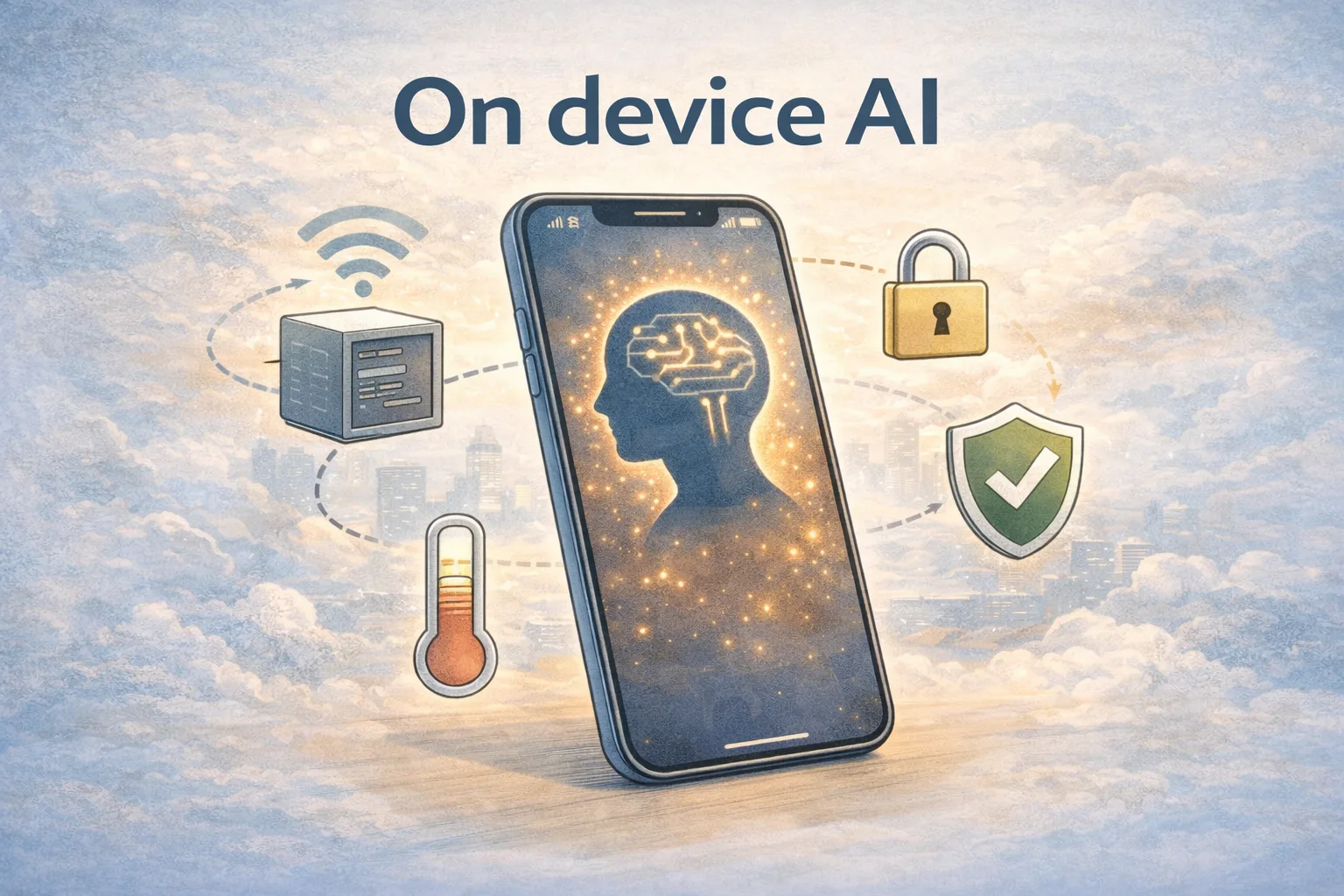
For the last couple of years, “adding AI” to a phone mostly meant bolting a chatbot onto an app and calling it a feature. That phase is largely over. The more interesting shift in 2026 isn’t whether your phone has AI — nearly all of them do now — it’s where that AI actually runs: in the cloud, on the device itself, or increasingly, some hybrid of both. That distinction has real, practical consequences for privacy, speed, and even how much storage your next phone needs.
What “On-Device AI” Actually Means
On-device AI runs machine learning models directly on your phone’s hardware rather than sending your request to a remote server. Apple Intelligence and Google’s Gemini Nano are the two most prominent examples, and both rely on a dedicated Neural Processing Unit (NPU) — specialized silicon built specifically for this kind of computation, distinct from the phone’s main processor. When a task runs on-device, your data never leaves the phone, the response is essentially instant since there’s no network round-trip, and the feature keeps working even with no signal or Wi-Fi.
Why Privacy Is the Headline Feature, Not Just Marketing
Privacy is the most tangible benefit of on-device processing, and it matters most in specific categories: health data, financial information, journaling, and private messages. When Apple processes a request for Writing Tools or notification summaries on-device, that data genuinely doesn’t leave your phone — no server round-trip, no data retention question to worry about. Apple has built its entire AI narrative around this distinction, with Tim Cook framing it directly: users shouldn’t have to choose between intelligence and privacy. Google has taken a similar transparency approach with Gemini Nano, including a toggle that lets users disable cloud processing entirely for supported tasks.
Where On-Device AI Still Falls Short
The tradeoff is capability. On-device models are necessarily smaller than their cloud-based counterparts — there’s only so much a phone’s NPU can handle — which means on-device AI excels at fast, narrow tasks like proofreading, summarizing a notification, or basic photo editing, but hits a ceiling on tasks requiring deep reasoning or broad, current knowledge. For anything more complex, both Apple and Google route the request to cloud infrastructure: Apple through what it calls Private Cloud Compute, designed so that even Apple can’t access the data being processed, and Google through standard Gemini cloud models when a task exceeds what Gemini Nano can handle locally.
This hybrid approach — not purely on-device, not purely cloud — is where the industry has actually settled, despite the privacy-first marketing framing. Most everyday AI features on a modern phone are quietly deciding, task by task, whether to keep things local or reach out to the cloud.
The Storage Cost Nobody Talks About Enough
Running capable AI models locally requires real storage space, and this has become one of the more underdiscussed practical impacts of the on-device AI shift. Industry guidance increasingly points toward 256GB as a realistic minimum for anyone who wants full access to on-device AI features going forward, with 512GB recommended for heavier use — a meaningful consideration when configuring a new phone purchase, and part of why base storage tiers have been creeping up across the industry rather than staying flat.
Which Phones Actually Support This
Apple Intelligence requires an iPhone 15 Pro or newer, reflecting the NPU horsepower needed to run the models locally at acceptable speed. On the Android side, Gemini Nano support centers on Google’s own Pixel lineup (Pixel 8 Pro and newer handle it particularly well) and select Samsung Galaxy S25-and-newer devices, as chipmakers across the industry race to bundle more capable NPUs into their silicon. If you’re shopping for a phone specifically for its on-device AI capability, checking NPU specifications — not just raw CPU benchmarks — has become a genuinely relevant part of the buying decision, alongside more traditional considerations like the camera comparisons for this year’s top phones.
A 2026 Wrinkle: Apple and Google Are Now Partners
One of the more notable developments this year is that Apple entered a 2026 partnership with Google to use Gemini for certain AI services on iPhone — a sign that even Apple’s famously self-contained approach has limits when it comes to matching the depth of Google’s cloud-scale models. This doesn’t change Apple’s on-device privacy story for the features that stay local, but it’s a reminder that the “Apple vs. Google AI” framing increasingly undersells how much both companies now lean on each other’s infrastructure behind the scenes.
The Bottom Line
On-device AI isn’t a marketing buzzword at this point — it’s a genuine architectural shift in how phones handle everyday intelligence, with real consequences for privacy, speed, and the storage tier you should be buying. The practical upshot for most buyers: prioritize NPU capability and storage headroom over chasing the highest possible on-device feature count, since most of what actually improves day to day is quietly handled by the hybrid system working in the background rather than any single flagship AI feature. For a deeper technical breakdown of NPU performance across current chips, Qualcomm’s overview of on-device AI processing is a solid technical primer.