
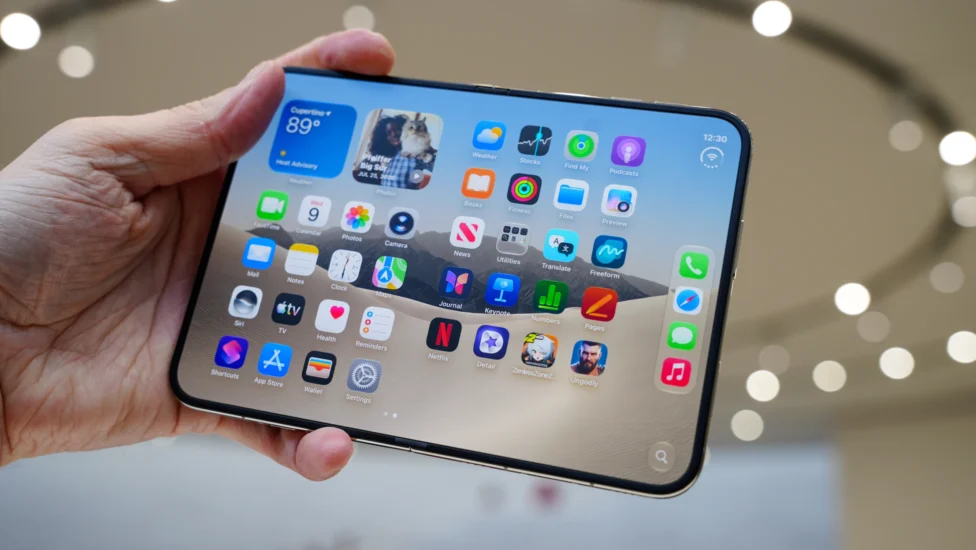
After roughly eight years of rumors, leaks, and “maybe next year” predictions, Apple has finally shipped a foldable iPhone. Announced on September 9 alongside the iPhone 18 Pro and Pro Max, the iPhone Duo is Apple’s first device with two displays — and its most expensive iPhone ever by a wide margin. Here’s everything confirmed so far.
Price and Release Date
The iPhone Duo starts at $1,999 for the 256GB model. Pre-orders open at 5:00 a.m. Pacific Time on Friday, October 16, with the phone launching in more than 70 countries on Friday, October 23, 2026. That’s a notably later release than the standard iPhone 18 lineup, which suggests Apple wanted extra runway to finalize production on a genuinely new form factor before shipping at scale.
For a look at how the Duo’s pricing compares to the rest of this year’s iPhone lineup, our iPhone 18 Pro & Pro Max pricing breakdown covers the standard flagship models side by side.
Design: A Book, Not a Clamshell
Unlike Samsung’s Z Flip series, the iPhone Duo opens like a book rather than a compact clamshell. Closed, it shows a 5.4-inch outer display; unfolded, it reveals a 7.6-inch inner screen. Apple describes the interior display as the largest ever fitted to an iPhone, offering roughly 50% more screen area than the iPhone 18 Pro Max, while the outer display alone covers more than 90% of the screen real estate of a standard iPhone 18 Pro — meaning the Duo functions as a fully capable phone even before you unfold it.
The design itself borrows a “passport” shape: curved corners along the right edge, squared-off corners near the hinge, and a body that’s wider than it is tall once opened. Apple built the frame from grade 5 titanium, with the hinge itself using a titanium-and-aluminum blend engineered specifically to minimize the crease that’s plagued nearly every foldable phone on the market to date. The device carries an IP68 rating, putting it on equal footing with standard iPhones for splash, water, and dust resistance — a detail that matters more than it might seem, since foldables have historically struggled to match the durability of traditional phone designs.
What Apple Cut to Make It Work
Every foldable phone involves trade-offs, and the Duo is no exception. Apple dropped Face ID entirely on this device, replacing it with a Touch ID sensor built into the side power button — the same approach used on iPads and some earlier iPhone models. The interior selfie camera sits hidden beneath the display itself, an under-screen camera implementation Apple has never shipped on an iPhone before.
On the rear, the Duo skips a telephoto lens entirely, a notable omission for a phone at this price point and one that separates it clearly from the camera system on the iPhone 18 Pro Max. Apple appears to be positioning the Duo around foldable versatility and screen real estate rather than trying to match the Pro Max’s camera system feature-for-feature — a trade-off worth weighing carefully if photography is a top priority for you.
The display itself uses what Apple calls a “nano-texture” matte finish, designed to reduce glare and reflections — a feature previously reserved for Apple’s Pro Display XDR monitor and iPad Pro, now making its way to a phone screen for the first time.
Battery Life
Apple rates the iPhone Duo for up to 44 hours of video playback, a genuinely strong figure that suggests the company prioritized battery capacity heavily given the extra internal volume a book-style folding design allows compared to a slab phone. Real-world battery life during actual multitasking on the larger interior display will likely run lower than that headline figure, as is typical with manufacturer battery claims, but it signals Apple treated battery life as a priority rather than an afterthought squeezed in around the folding mechanism.
How It Compares to Samsung’s Foldables
Apple isn’t entering an empty category. Samsung’s Galaxy Z Fold8 Ultra launched shortly before the Duo at $2,099.99, measuring a remarkably thin 4.1mm when unfolded — reportedly thinner than early rumors suggested the Duo would manage. That puts Apple in the unusual position of joining the foldable race not as the category’s innovator, but playing catch-up on pure hardware thinness against a competitor with eight generations of manufacturing experience refining hinge design and crease reduction.
Where Apple may have an edge is exactly the problem Samsung and other foldable makers have struggled with for years: the visible crease down the center of the inner display. Early hands-on reports — including from people who reportedly tested pre-release units — have specifically praised the hinge’s sturdiness and the phone’s pocketability, though independent, widely available reviews will be needed to confirm how the Duo holds up to the crease problem over months of real-world folding and unfolding.
Comparison at a Glance
| Spec | iPhone Duo | iPhone 18 Pro Max | Galaxy Z Fold8 Ultra |
| Starting price | $1,999 | ~$1,299 (est.) | $2,099.99 |
| Outer/cover display | 5.4” | — | 6.5” (approx.) |
| Inner display | 7.6” | — | 8” (approx.) |
| Biometrics | Touch ID (side button) | Face ID | Fingerprint (side button) |
| Telephoto lens | No | Yes | Yes |
| Water resistance | IP68 | IP68 | IP48 |
| Release date | Oct 23, 2026 | Sept 2026 | Available now |
Should You Buy It?
The iPhone Duo isn’t really a “bigger, better iPhone 18 Pro Max” — it’s a genuinely different kind of device aimed at a specific kind of buyer: someone who wants tablet-sized screen real estate for reading, multitasking, and productivity without carrying a separate iPad, and who’s willing to pay a significant premium and accept a weaker camera system to get it.
If you primarily care about having the best possible camera or want Face ID’s familiar convenience, the standard iPhone 18 Pro Max remains the safer, considerably cheaper choice. But if you’ve been waiting for Apple to bring its software polish and build quality to the foldable category — and you don’t mind spending roughly iPad-and-a-half money on a single device — the Duo is shaping up to be the most interesting iPhone Apple has released in years.
Given this is Apple’s first attempt at the format, it’s also worth waiting for independent, hands-on reviews covering long-term hinge durability and real-world battery performance before committing, rather than relying on launch-day marketing claims alone.
For Apple’s own full specifications and official details, see the iPhone Duo page on Apple’s website. MacRumors has also maintained an ongoing iPhone Duo coverage roundup tracking hands-on impressions as they’re published ahead of the October launch.
Frequently Asked Questions
Why doesn’t the iPhone Duo have Face ID? Apple replaced Face ID with a Touch ID sensor built into the side power button, likely to save internal space and simplify engineering around the folding mechanism and under-display selfie camera.
Is the iPhone Duo worth the price over a standard iPhone 18 Pro Max? It depends entirely on what you value. If screen real estate and multitasking matter more to you than camera quality and familiar Face ID unlocking, the Duo offers something the Pro Max simply can’t. If camera performance is your priority, the Pro Max remains the better value.
When can I actually buy one? Pre-orders begin October 16, 2026, with the phone available in stores starting October 23, 2026, across more than 70 countries.
Does the iPhone Duo have a visible crease like other foldables? Apple has engineered the titanium-aluminum hinge specifically to minimize crease visibility, and early hands-on impressions have been positive, but independent long-term reviews after the October launch will be the real test.
For more of the latest smartphone launches and hands-on coverage, browse our full Smartphones section, or check our Gadgets & Accessories coverage for cases and accessories built for foldable devices.