
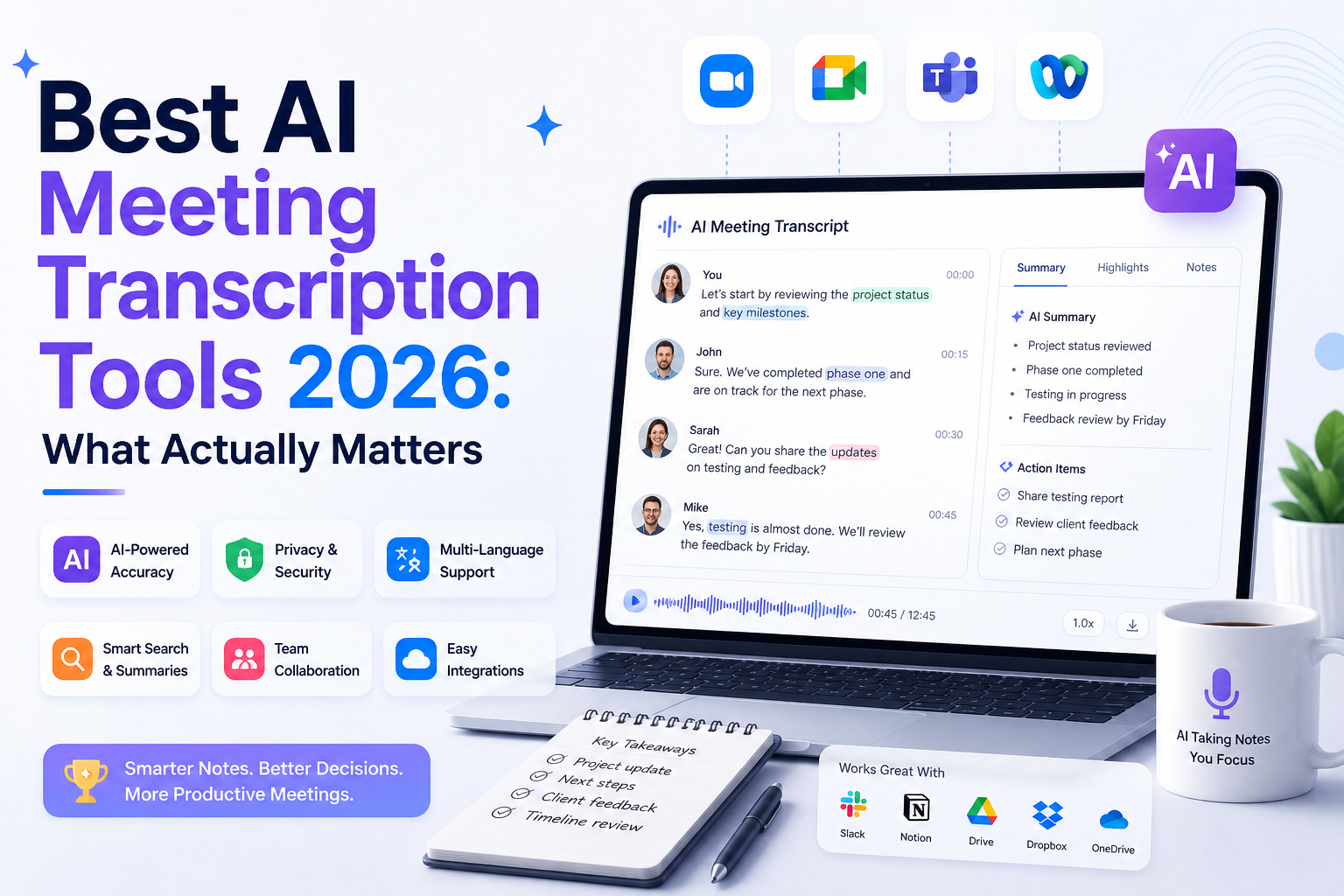
AI meeting transcription and note-taking tools have gone from a nice-to-have to a genuine productivity staple for anyone attending regular calls, with accuracy and summarization quality improving enough in 2026 that many users have fully replaced manual note-taking. Our Top Productivity Apps guide covers other tools worth pairing with a transcription assistant for a more complete meeting workflow.
Transcription Accuracy Has Genuinely Improved
Modern AI transcription tools handle accents, technical vocabulary, and multiple simultaneous speakers considerably better than the tools available even two years ago, though accuracy still varies by audio quality, background noise, and speaker overlap. a comparison of transcription accuracy from PCMag regularly benchmarks these tools against real-world meeting audio rather than clean studio recordings, which gives a more realistic picture of everyday performance.
Summarization Quality: The Real Differentiator Now
With transcription accuracy reaching a reasonably high baseline across most major tools, the actual differentiator has shifted to summarization quality — how well a tool identifies key decisions, action items, and follow-ups from a raw transcript, versus producing a generic, unfocused summary that requires as much review time as the original recording would have.
Best for Action Item Tracking
The strongest tools in this category don’t just summarize discussion, they actively identify and extract specific action items with assigned owners and deadlines when mentioned, sometimes integrating directly with task management tools to automatically create follow-up tasks. This automation genuinely reduces the administrative overhead of translating meeting outcomes into actual tracked work.
Privacy and Consent Considerations
Recording and transcribing meetings raises real legal considerations depending on your jurisdiction — some regions require all-party consent before recording a conversation, while others only require one-party consent. Using an AI transcription tool without properly informing meeting participants can create genuine legal exposure depending on where participants are located. a state-by-state overview of recording consent laws is worth reviewing if you regularly record calls with participants across different states or countries.
Best for Multi-Language Meetings
For international teams, real-time translation alongside transcription has become a genuinely useful feature in top-tier tools, though translation quality for nuanced business discussion still trails native-language transcription accuracy. For critical negotiations or legally significant discussions involving multiple languages, human interpretation remains more reliable than relying solely on AI translation.
Integration With Existing Workflow Tools
- Calendar integration that automatically joins and records meetings without manual setup each time
- Direct integration with project management tools for automatic action item creation
- Searchable transcript archives that let you find specific past discussions by keyword rather than manually reviewing old recordings
- Export options compatible with your team’s existing documentation tools
Data Security for Sensitive Business Discussions
For meetings involving sensitive business, legal, or financial information, checking a transcription tool’s data handling policies — where transcripts are stored, whether they’re used for model training, and available enterprise-grade security certifications — matters considerably more than for casual internal meetings. Enterprise tiers typically offer stronger data isolation guarantees than consumer or free tiers.
Handling Poor Audio Quality and Cross-Talk
Real-world meetings rarely have studio-quality audio — background noise, participants speaking over each other, and inconsistent microphone quality across attendees all degrade transcription accuracy in practice compared to clean demo conditions. The strongest tools handle overlapping speech more gracefully, correctly attributing interrupted or simultaneous statements to the right speaker rather than merging them into a confusing jumble. Testing a tool against your team’s actual typical meeting conditions, rather than trusting polished demo videos, gives a much more realistic sense of expected accuracy.
The Bottom Line
AI meeting transcription tools in 2026 have matured well beyond basic speech-to-text into genuinely useful action-item extraction and workflow integration. Prioritize summarization quality and workflow integration over raw transcription accuracy alone, since most major tools have reached a reasonably high accuracy baseline, and always confirm consent requirements before recording calls with external participants.