
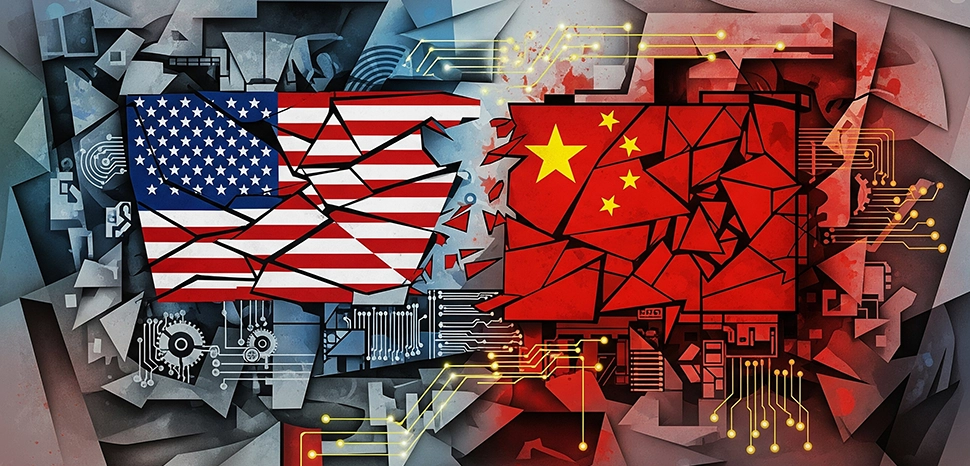
A genuinely serious safety debate — one warning AI could pose existential risk within a decade — has increasingly been reframed as a competitiveness argument against China. Understanding why that shift happened matters for predicting whether any real slowdown ever actually occurs.
The Core Tension Driving This
Even Anthropic’s Dario Amodei, the person who kicked off this month’s slowdown debate, has acknowledged the risk of moving too cautiously. According to Business Standard’s coverage of the dynamic, Amodei recognizes that slowing down too much could let China close the technological gap — meaning even AI safety’s most prominent advocate has to weigh restraint against a genuine competitive risk.
How Close the US-China Gap Actually Is
According to reporting on Stanford’s 2026 AI Index, the performance gap between the top Chinese and American AI models has narrowed to roughly 2.7% as of early 2026 — a genuinely thin margin that makes the “can’t afford to slow down” argument considerably more concrete than it would be if the US maintained a wide, comfortable lead.
Trump’s Position, and Why It Resonates Politically
President Trump has directly tied the AI safety debate to the China race, saying “whoever wins AI, wins,” and dismissing coordinated slowdown proposals as a competitive risk rather than engaging with the underlying safety argument on its own terms. House Speaker Mike Johnson echoed this, warning that rushing AI restrictions through Congress could itself become a “national security threat” by handing China an advantage.
China’s Own Public Position
Chinese President Xi Jinping has called for a “consensus-based global AI governance framework” and pledged open-source AI models and technical training specifically to BRICS nations — positioning China as a technology partner to the Global South, a framing that directly competes with Western AI dominance rather than simply racing to match it capability-for-capability.
Why Genuine US-China Cooperation Looks Unlikely
David Sacks, a White House AI advisor, has been blunt about the obstacle: “China is very unlikely to join a global agreement,” he said, according to BeInCrypto’s reporting on the dynamic. Separately, China has reportedly told the US that safety talks can’t proceed until both sides agree on what “AI safety” actually means in the first place — a foundational disagreement that predates any discussion of specific coordinated measures.
Why This Reframing Genuinely Worries Some Safety Advocates
Jacob Coxon, the former Anthropic researcher whose resignation kicked off this month’s broader public debate, has specifically argued for cooperation between the US and China on this issue — a notably different framing than the pure competitiveness argument dominating political discussion, and one that’s gotten considerably less traction in Washington than the “don’t lose to China” framing has.
What This Means for Businesses Planning Around AI Regulation
As long as AI safety remains politically framed primarily as a competitiveness question, meaningful US regulation of frontier AI development looks unlikely in the near term, regardless of how loudly individual lab leaders call for restraint. Businesses tracking [CLIENT LINK PLACEHOLDER] how the safety-versus-competitiveness framing is likely to shape actual US policy timelines should plan around continued rapid capability releases rather than anticipating near-term binding restrictions.
Frequently Asked Questions
Is China actually ahead of the US in AI development?
Not according to current benchmarks — Stanford’s 2026 AI Index shows the US still leads, but by a narrow and shrinking margin of roughly 2.7%, which is part of why the competitiveness argument carries real political weight.
Have the US and China had any formal AI safety talks?
Discussions have been reported, but China has indicated that substantive talks require the two countries to first agree on a shared definition of AI safety, which hasn’t yet happened.
The Bottom Line
The AI safety debate has become inseparable from US-China competitiveness politics, and that reframing — more than any individual CEO’s public statement — may be the biggest practical obstacle to any genuine, coordinated industry slowdown actually happening.