
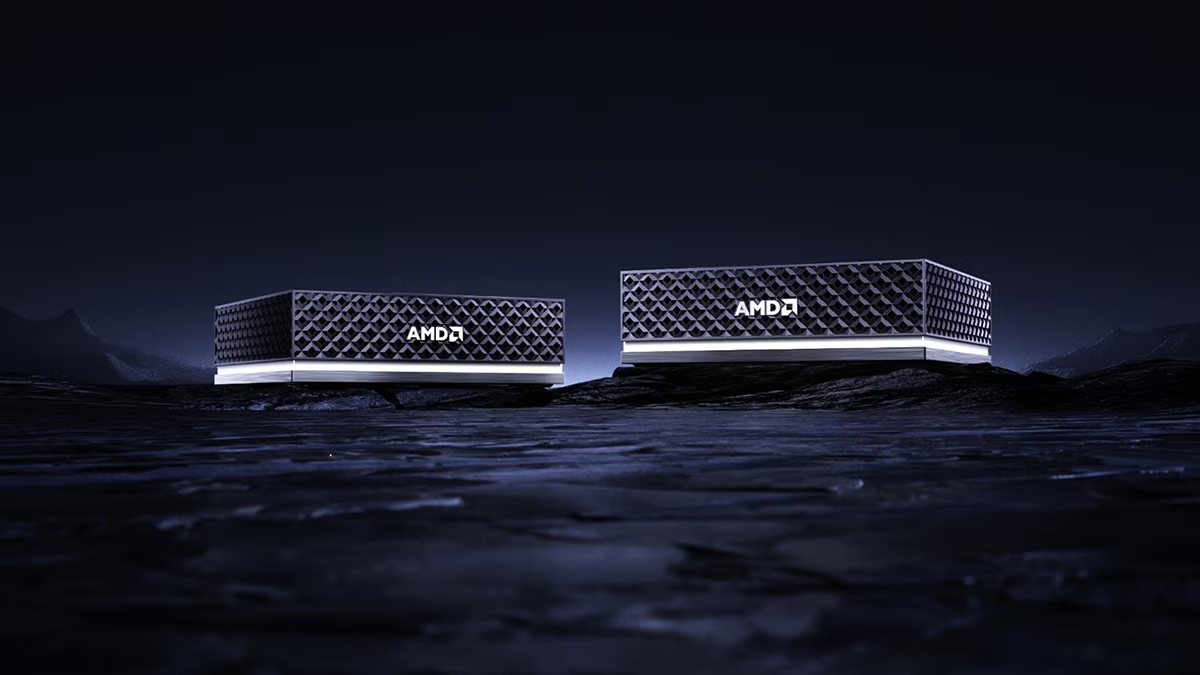
Mini PCs used to mean one thing: a small, cheap box for browsing and office work. That definition just broke. A new wave of mini PCs built around AMD’s Ryzen AI Max+ PRO 495 processor is arriving with up to 192GB of unified memory — enough to run large language models with hundreds of billions of parameters entirely offline, no cloud subscription required.
GMKtec, Acemagic, and Framework have all shown systems built on this chip in 2026, and GMKtec is even marketing its version as an “Agentic PC” — a machine built specifically to run autonomous AI agents locally, a trend we’ve also covered in how AI agents are changing everyday apps in 2026. Here’s what’s actually inside these machines, what they’re good for, and who should — and shouldn’t — consider buying one.
What Is the Ryzen AI Max+ PRO 495?
The Ryzen AI Max+ PRO 495, codenamed “Gorgon Halo,” is AMD’s flagship chip in the Ryzen AI Max PRO 400 series, which the company confirmed in May 2026. It’s best understood as a refined evolution of 2025’s popular Ryzen AI Max+ 395 (Strix Halo) chip rather than a ground-up redesign — but the upgrades matter for anyone doing serious local AI work, as detailed in Wccftech’s full specs breakdown.
Key specifications:
- 16 Zen 5 CPU cores / 32 threads, boosting up to 5.2GHz
- 64MB of cache
- Radeon 8065S integrated graphics with 40 compute units, clocking up to 3.0GHz, with hardware ray tracing support
- XDNA 2 NPU rated at up to 55 TOPS for dedicated AI acceleration
- Up to 192GB of unified LPDDR5X-8533 memory — up from 128GB on the previous-generation chip
- ~273GB/s of memory bandwidth
- Configurable 45W–120W TDP, letting manufacturers tune performance versus power draw
The headline upgrade is that jump from 128GB to 192GB of unified memory, with up to 160GB configurable as graphics memory (VRAM). Because the CPU and GPU share the same fast memory pool instead of relying on separate, smaller VRAM, these chips can load AI models that would normally require a dedicated workstation GPU costing many times more.
Meet the Machines: GMKtec, Acemagic, and Framework
GMKtec EVO-X5 Pro
Unveiled at IFA Berlin 2026, the EVO-X5 Pro is GMKtec’s flagship “Agentic PC” — its term for a machine built to run autonomous, multi-step AI workflows locally rather than round-tripping data to the cloud. Full coverage of the launch, including hands-on impressions, is available via TechRadar’s report from IFA 2026. It ships in a machined metal chassis with:
- Up to 192GB LPDDR5X memory
- Four USB4 ports (up to 80Gbps)
- HDMI 2.1, 10Gb and 2.5Gb Ethernet, three PCIe 4.0 M.2 slots
- A vapor chamber and three-fan cooling system rated to dissipate up to 132W
- A fingerprint reader built into the power button and a dedicated dTPM 2.0 security chip
- GMKtec claims the system can run AI models up to roughly 300 billion parameters locally when using INT4 quantization
GMKtec says the EVO-X5 Pro will launch in October 2026; pricing has not been announced yet.
Acemagic F9A
Acemagic’s take squeezes the same PRO 495 chip and up to 192GB of memory into a notably smaller ~2-liter enclosure (158.5 × 158.5 × 81.5mm). It includes OCuLink support for connecting an external GPU — a feature GMKtec’s EVO-X5 Pro skips in favor of its high-speed USB4 ports.
Framework Desktop (PRO 495 configuration)
Framework — the company best known for repairable, upgradeable laptops — is preparing a desktop model using the PRO 495 with 192GB of memory and 273GB/s of bandwidth, in a compact 4.5-liter case with an optional Linux preload. This appeals directly to developers who want a small, quiet, Linux-friendly box for local AI experimentation. If local productivity hardware is on your radar generally, our best AI meeting transcription tools of 2026 roundup is a useful companion read.
Comparison Table: Ryzen AI Max+ PRO 495 Mini PCs
| Model | Max Memory | Chassis Size | Standout Feature | Expected Launch |
|---|---|---|---|---|
| GMKtec EVO-X5 Pro | 192GB LPDDR5X | Metal desktop chassis | “Agentic PC” branding, 4x USB4, vapor chamber cooling | October 2026 |
| Acemagic F9A | 192GB LPDDR5X | ~2 liters (very compact) | OCuLink external GPU support | 2026 (TBD) |
| Framework Desktop | 192GB LPDDR5X | 4.5 liters | Repairable design, optional Linux preload | 2026 (TBD) |
What Can You Actually Do With 192GB of Unified Memory?
This is the question that matters most. In practical terms, this class of hardware is aimed squarely at:
- Running large language models locally — GMKtec claims support for models up to roughly 300B parameters, avoiding per-token API costs and keeping sensitive data off third-party servers.
- Local AI agents and automation — running multi-step, autonomous AI workflows entirely on-device, which is where GMKtec’s “Agentic PC” framing comes from.
- AI development and fine-tuning for engineers who want a personal machine instead of renting cloud GPU time.
- Creative and technical workloads that benefit from large, fast unified memory — video editing, 3D rendering, and data science, though a dedicated discrete GPU will still outperform integrated graphics for heavy gaming or professional rendering.
What it’s not built for: casual users who just want a fast everyday PC. For browsing, office work, and streaming, this hardware is dramatic overkill — and priced accordingly. Reports on comparable configurations from this new wave of mini PCs put fully specced systems in the $2,000–$8,000 range depending on memory and storage configuration, positioning them closer to professional workstations than consumer desktops — full pricing context is available via Guru3D’s pricing roundup.
Who Should Actually Buy One?
Good fit if you’re:
- A developer or AI engineer who wants to run and fine-tune large models without cloud costs or data-privacy concerns
- A small business or research team that needs offline AI processing for compliance or security reasons
- Someone replacing a much larger, louder workstation tower with a compact, quiet alternative that still handles serious AI workloads
Skip it if you’re:
- Looking for a general-purpose home or office PC — a mainstream mini PC or laptop will do the job for a fraction of the price
- Primarily a gamer — a discrete GPU-based desktop will outperform these systems in most AAA titles
- Not planning to run local AI models at all — the premium price only makes sense if you’re actually using the memory capacity
The Bottom Line
The Ryzen AI Max+ PRO 495 marks a real shift in what a “mini PC” can mean. Packing 192GB of fast unified memory and a dedicated 55 TOPS NPU into a box the size of a small toaster makes serious local AI work possible without a rack-mounted server or a cloud bill. For AI developers, privacy-conscious professionals, and local-LLM enthusiasts, machines like the GMKtec EVO-X5 Pro, Acemagic F9A, and Framework Desktop are genuinely exciting — but for everyone else, this remains a specialized, premium-priced category rather than a mainstream upgrade.